 Skip-the-line available
 Mozart, the Jesuits and the Klementinum Mirror Chapel
An 11th-century chapel, four centuries of Jesuit ambition, a mirror-lined Baroque hall — and a January day in 1787 when Mozart walked in. The history behind the room the Klementinum tour meets beside.
Every visitor to the Klementinum passes the Mirror Chapel — the guided tour's meeting point sits directly beside it — and most walk past without realising what's behind the doors: a High Baroque hall lined with mirrors set into marble and gilded stucco, two eighteenth-century organs, and a guest list that includes Wolfgang Amadeus Mozart, who first came here on 13 January 1787. The chapel is the most concentrated expression of what the Klementinum was for two centuries: the Jesuit order's great Bohemian college, built to overwhelm the senses in the service of persuasion. This guide traces the whole arc — from an 11th-century chapel dedicated to Saint Clement, through the Jesuits' rise and their abrupt dissolution in 1773, to the Mozart visit the complex still trades on — and explains how to actually get inside the Mirror Chapel today, which the standard tour does not do.
Before the Jesuits: a chapel, a monastery, a war
The site's story starts long before the Baroque. An 11th-century chapel dedicated to Saint Clement — the Klementinum still carries his name — stood here by the riverside crossing that would later become the approach to Charles Bridge. In the medieval period a Dominican monastery grew up around the chapel, putting the site into the hands of a scholarly order centuries before the Jesuits arrived. Location was destiny: this corner of the Old Town controlled the route between the river crossing and the market square, which is exactly why every subsequent owner fought to hold it.
The Hussite Wars nearly ended the story. In 1420, the monastery was heavily damaged as Prague convulsed in the religious wars that made Bohemia notorious across Europe. The Dominicans' establishment never fully recovered its position, and for over a century the site sat as underused ecclesiastical property in a city that had become a stronghold of the Hussite, anti-Roman tradition. That context matters for everything that follows: when the Jesuits were sent to Prague, they were being sent into hostile territory.
In 1556 the transformation came. The Society of Jesus — founded only sixteen years earlier — took over the old Dominican site and established a college, the spearhead of the Counter-Reformation's campaign to win Bohemia back. The choice of site was strategic to the point of bluntness: directly on the main route into the Old Town, opposite the bridge, in the middle of a Protestant-leaning city. The Klementinum was conceived from day one as architecture with an argument.
The Jesuit century — building a rival to the castle
The Jesuits played a long game, and its currency was education. Their college grew into the dominant educational institution in Bohemia, absorbing intellectual assets as it went: in 1622 the library of Charles University — the oldest university in central Europe — was transferred to the Klementinum, and in 1654 the college was formally merged with the university itself. Within a century of arriving as missionaries in a hostile city, the Jesuits controlled the core of Bohemian higher learning from this one block.
The architecture kept pace with the ambition. Piece by piece the order bought up and demolished the surrounding houses, until their college filled an entire city block — some 20,000 square metres, which still makes the Klementinum the second largest building complex in Prague after Prague Castle. The comparison is the point: in a city dominated by the royal castle on the opposite bank, the Jesuits raised a secular-scaled monument to their own order in the heart of the merchant town.
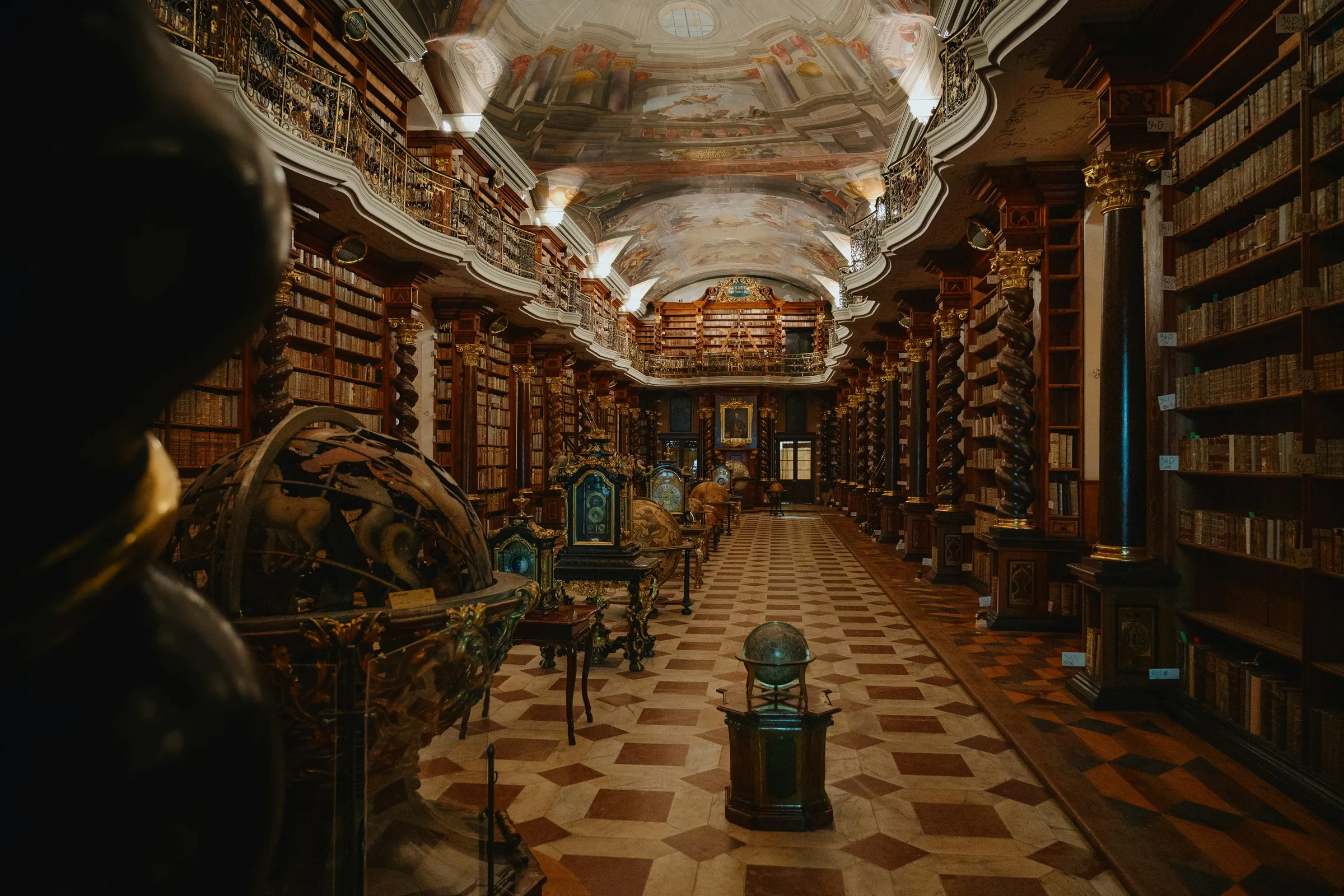
The great building phase came late, between 1709 and 1726, and produced the rooms visitors queue for today: the Baroque Library Hall with its Jan Hiebl frescoes, the Astronomical Tower of 1722, and the Mirror Chapel. It's worth holding the dates in mind on a visit — nearly everything you see was built in a single seventeen-year burst, a coordinated statement of confidence made, with hindsight, barely fifty years before the order was dissolved.
The intellectual traffic through the complex in those years was remarkable. The college's library, swollen by the university collections it had absorbed in 1622, was growing into one of central Europe's great book stores; its halls trained the administrators and clergy of the Bohemian lands; and the national collections that would later be housed here include materials relating to Tycho Brahe — the imperial astronomer whose Prague years made the city briefly the centre of European science — and to Comenius, the great Czech educational reformer. The Klementinum was never only a religious institution; it was the machine room of Bohemian learning, which is exactly why it survived its builders.
The Mirror Chapel — persuasion by reflection
The Mirror Chapel was built between 1722 and 1726 for the college's Latin Marian Congregation — a Jesuit lay confraternity — and its architect is genuinely uncertain: attributions point to either František Maxmilián Kaňka or Kilián Ignác Dientzenhofer, the two leading names of Prague's High Baroque. What is not uncertain is the effect. The chapel's signature is the unusually extensive use of mirrors set into the decoration of both the walls and the vault, interleaved with marble, gilded stucco, frescoes and paintings until the surfaces dissolve into reflections of each other.
Mirrors in a chapel were not vanity — they were theology by other means. Baroque devotional architecture aimed to overwhelm, to make heaven sensorily present, and mirrored surfaces multiplied candlelight, gilding and painted sky in every direction. The room is small by the standards of the complex, which concentrates the effect; contemporary accounts and modern visitors converge on the same reaction, a slightly disoriented delight. It remains one of the most distinctive Baroque interiors in a city that does not lack competition.
The chapel's second treasure is sound. The original organ, built in 1732 by the organ builder Tomáš Schwarz, still occupies the choir loft; a second Baroque organ, brought from the church at Svatobor u Doupova, was installed in the 1950s where the main altar once stood. Two period organs in a mirrored stone room produce the acoustics that have made the chapel a working concert venue rather than a museum piece — which, as we'll see, is also the key to getting inside it.
13 January 1787 — Mozart in the Klementinum
Mozart arrived in Prague in January 1787 riding the astonishing local success of The Marriage of Figaro, and the city gave him the warmest reception of his career. On 13 January 1787 he first visited the Klementinum, and he returned several more times. The account preserved of that visit is charming in its specificity: students of the seminary played one of his own symphonies for him, and Mozart reciprocated with a performance of his own. A bust of the composer by the sculptor Emanuel Max stands in the Mirror Chapel's antechamber to mark the association.
Did Mozart play the Mirror Chapel's organ? Tradition says yes — the 1732 Schwarz organ is widely described as the instrument he touched — and honesty requires the footnote that his surviving letters don't mention it. What the record does support is presence: Mozart was in these halls, music was exchanged here, and the chapel's organs were the finest keyboard instruments in the building. The attribution is plausible tradition rather than documented fact, and the better guides present it exactly that way.
There's a fitting institutional postscript: the National Library that now occupies the Klementinum holds a collection of Mozartiana among its treasures. The building where seminarians once played his symphony back to him became one of the places his legacy is formally kept — a quieter, more durable connection than any anecdote about the organ loft.
The visit also tells you something about what the Klementinum was in 1787: no longer a Jesuit stronghold — the order had been dissolved fourteen years earlier — but a state library and seminary complex, secular enough that the most fashionable composer in Europe could drop in as a celebrity guest. Prague's love affair with Mozart, warmer than Vienna's, is part of the city's self-image to this day, and the Klementinum's chapel is one of the few surviving rooms where that affection played out in person rather than in a theatre. When the chapel's concert programmes lean on Mozart, they are not pandering; they are playing the house composer.
1773 and after — from Jesuit college to National Library
The Jesuit era ended with startling speed. In 1773 the papacy suppressed the Society of Jesus across Europe, and the order that had spent two centuries building the Klementinum lost it almost overnight. Empress Maria Theresa moved decisively to secularise the asset: the complex was established as an observatory, library and university institution — the scholarly machinery continuing under state direction with the missionary purpose amputated.
The library's rise was immediate. In 1781 the National Library was founded on the Klementinum's collections, and from 1782 the institution became a legal deposit library, entitled to a copy of published works — the mechanism that turned a Jesuit theological collection into a national archive of Czech print. The materials accumulated since span from mediaeval manuscripts to collections relating to Tycho Brahe and Comenius, and the Klementinum remains the seat of the National Library of the Czech Republic today. This is why visitor access runs on guided routes: the Baroque showpieces sit inside a working research institution.
The Mirror Chapel found its own second life. Deconsecrated purposes came and went until 1936, when the chapel settled into the role it has held ever since: a dedicated venue for concerts and cultural events. Today it hosts classical programmes, gatherings and even weddings — and it opens only for those events. That's the practical takeaway for visitors: the guided sightseeing route meets beside the chapel but does not tour its interior, so if you want to stand among the mirrors, book an evening concert. Hearing period repertoire on two Baroque organs' home ground, in candle-warm light multiplied by the vault's mirrors, is the closest available approximation of 13 January 1787 — and a far better way to experience the room than any walk-through would be.
Frequently asked
Did Mozart really play in the Klementinum?
Mozart first visited the Klementinum on 13 January 1787, during the Prague stay that followed the city's embrace of The Marriage of Figaro, and returned several more times. Seminary students played one of his symphonies for him and he performed in return. Whether he played the Mirror Chapel's 1732 Schwarz organ specifically is tradition rather than documented fact — his letters don't mention it — but his presence in these halls is well recorded.
Can I see the Mirror Chapel on the Klementinum guided tour?
The tour's meeting point is directly beside the Mirror Chapel, but the sightseeing route itself covers the Baroque Library viewing, the Meridian Hall and the Astronomical Tower. The chapel opens only during events — so to see the interior, book one of the classical concerts or cultural events held there. The concert also lets you hear the room, which is the point of it.
Why is it called the Mirror Chapel?
For the unusually extensive use of mirrors set into the decoration of both the walls and the vaulted ceiling, combined with marble, gilded stucco, frescoes and paintings. The mirrors multiply light and painted surfaces in every direction — a deliberate piece of Baroque sensory theatre built between 1722 and 1726 for the Jesuit college's Marian Congregation.
Who built the Klementinum?
The Jesuit order, over roughly 170 years. They took over a war-damaged former Dominican site in 1556, absorbed the Charles University library in 1622, merged with the university in 1654, and carried out the main building phase from 1709 to 1726 — producing the Baroque Library, the Astronomical Tower and the Mirror Chapel. The result is Prague's second largest building complex after Prague Castle.
What happened to the Jesuits at the Klementinum?
The Society of Jesus was suppressed by the papacy in 1773, and Empress Maria Theresa converted the complex to state purposes as an observatory, library and university institution. The National Library was founded on its collections in 1781, with legal deposit status from 1782. The Klementinum has been the home of the Czech national library ever since.
Are there still concerts in the Mirror Chapel?
Yes — the chapel has been used as a concert and events venue since 1936, and classical programmes are staged there regularly, played in a room holding two Baroque organs, including the original 1732 instrument by Tomáš Schwarz in the choir loft. Concert tickets are separate from the daytime guided sightseeing tour of the library, Meridian Hall and tower.