 Skip-the-line available
 The Klementinum Noon Signal and the Prague Meridian
For 86 years, all of Prague set its watches by a flag waved from the Klementinum's Astronomical Tower — triggered by a beam of sunlight crossing a string on the floor of the Meridian Hall. This is the story the tour tells at its best stop.
Every city needed a way to agree on noon before radio and standardised time zones, and Prague's answer was more elegant than most. In the Meridian Hall on the second floor of the Klementinum's Astronomical Tower, a thin beam of sunlight entered through a slit in the wall and crept across the floor until it merged with a stretched string marking the local meridian. At that instant it was solar noon in Prague — and from 1842 until the end of January 1928, an astronomer signalled the moment to the whole city by waving a flag from the tower's gallery. From 1891, a cannon across the river answered the flag with a shot. The Meridian Hall survives intact, its instruments in place, and it is one of the three stops on the Klementinum's guided sightseeing route. Here's the full story behind the room — and where to find the meridian's other traces around the Old Town.
The Meridian Hall — a room built to catch one moment a day
The Meridian Hall occupies the second floor of the Astronomical Tower, on the climb between the Baroque Library viewing and the top gallery. Its mechanism is disarmingly simple. A narrow slit in the southern wall admits a blade of sunlight; a string stretched across the floor marks the line of the local meridian — the north-south line passing through the tower. As the sun climbs toward its highest point, the beam slides across the floor, and the moment it aligns with the string is true solar noon for Prague. No clockwork, no lenses: just geometry, sunlight and a taut cord.
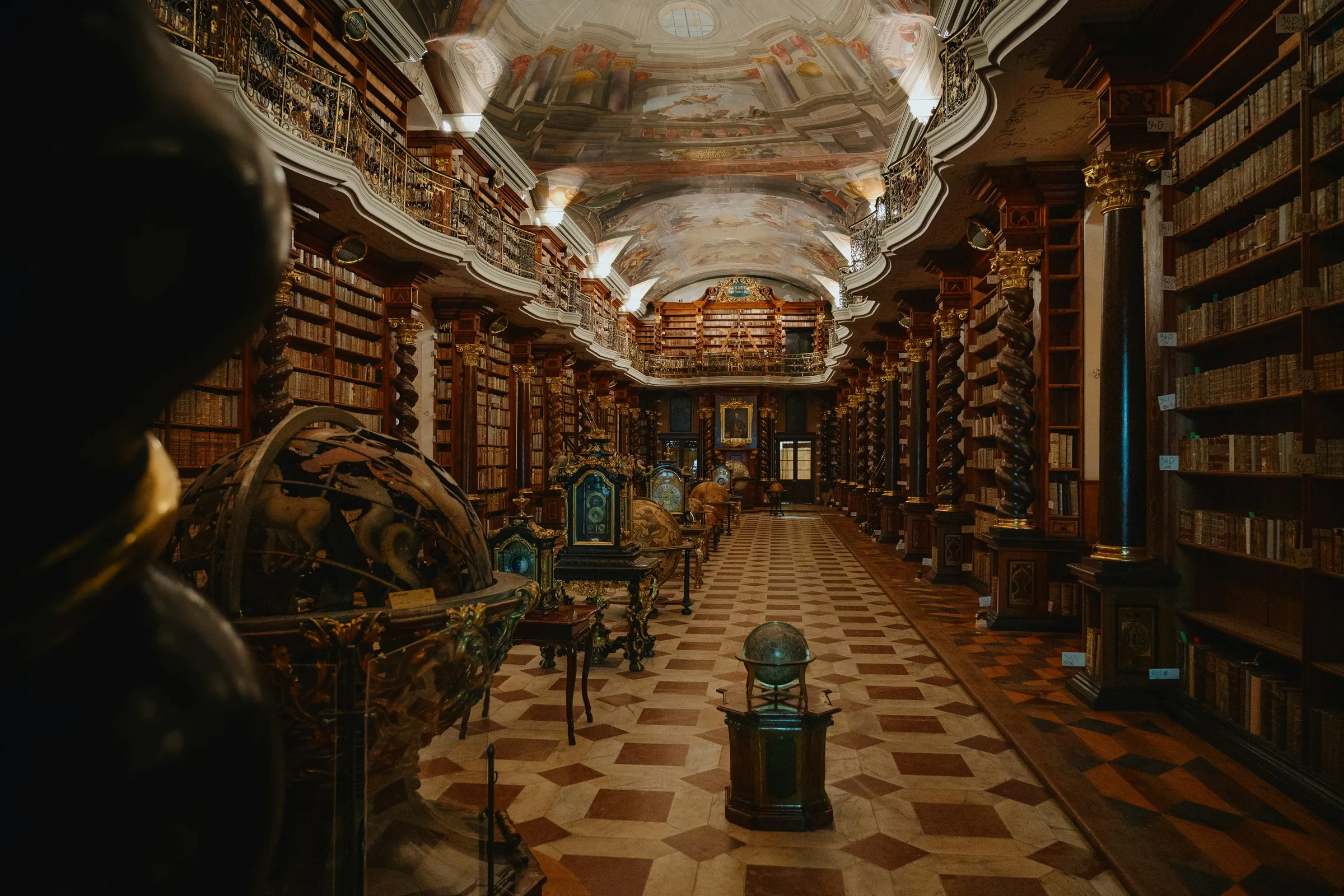
The hall doubles as a small museum of the tower's working life. Period astronomical instruments are displayed along its walls — the quadrants, sundials and measuring devices used when the Klementinum was a serious observatory rather than a viewpoint. The room's survival is remarkable in itself: this is not a reconstruction but the actual working chamber, with the actual slit, kept essentially as the astronomers left it. The guided tour pauses here on the way up the tower, and it's worth positioning yourself where you can see the slit and the floor line together — the whole system makes sense in one glance.
One caveat your guide will likely mention: solar noon is not 12:00 on your phone. Solar time drifts against clock time through the year, and modern Central European Time is standardised across a whole zone. The string-and-sunbeam method gave Prague its own local noon — which is precisely why, once railways and telegraphs demanded synchronised schedules, systems like this one were doomed. The hall is a monument to the last era in which time was a local, astronomical fact.
The flag on the tower: 1842 to 1928
From 1842, the Klementinum's astronomers turned their private observation into a public service. When the sunbeam in the Meridian Hall touched the string, a signal went up the tower, and from the gallery — the same balcony visitors stand on today, 52 metres up — a flag was waved to announce noon to the city. Anyone in sight of the tower could set their watch by it: merchants on Old Town Square, boatmen on the Vltava, clerks in windows across the roofscape. The service ran daily for 86 years.
The flag's reach explains why the Astronomical Tower dominates its skyline the way it does. At 68 metres, crowned since 1723 with Matyáš Bernard Braun's lead statue of Atlas carrying a celestial sphere, the tower was visible from most of the right-bank city. The signal turned it into civic infrastructure: a public clock with no face, read by the whole of Prague at once. Guides like to point out that the gallery you're photographing the castle from is the exact spot the flag-waver stood.
The system outlived its necessity by decades. A radio time signal began broadcasting in 1925, giving anyone with a receiver a more precise reference than any flag, and on 31 January 1928 the tower signal was abolished. Eighty-six years of daily flag-waving ended quietly, three years into the radio era — a neat illustration of how long a beloved civic ritual can outlast its technical justification.
To understand why a flag mattered, remember what time was before standardisation: a local fact. Every town kept its own solar time, and a traveller riding west from Vienna reset his watch as he went. The Klementinum's signal was authoritative precisely because it came from astronomers — the people with the instruments and the meridian line — rather than from any town-hall clock, which drifted and needed setting against something. The tower flag was the something. Only with the spread of railways, telegraphs and finally standardised zone time did the idea of a city having its own noon fade, and the Klementinum's ritual with it.
The cannon on Letná — noon with artillery
A flag has one weakness: you have to be looking at it. So from 1891 Prague added an audible layer to the noon signal — a cannon positioned on the Letná plain, the high ground across the Vltava north of the Old Town, sited in line with the Prague meridian. The gun crew watched the Klementinum tower; when the flag went up, the cannon fired, and the report carried across districts that had no sightline to the tower at all. Flag for the eyes, cannon for the ears.
The relay is worth picturing in sequence, because it's a complete pre-electric time network: sunlight crosses a string on a floor in the Old Town; a man two storeys up waves a flag; artillerymen a kilometre away across the river see it and fire; and a city of hundreds of thousands winds its watches. Every link is human and analogue, and the whole chain executes in seconds. The cannon shots continued into the 1920s before the practice ended along with the rest of the pre-radio signalling.
Standing on the tower gallery today, you can reconstruct the geography in one look: Letná's green ridge sits plainly across the river to the north. It's one of the better payoffs of knowing the story before you climb — the panorama stops being generic prettiness and becomes a diagram of how the city once agreed what time it was.
The observatory behind the signal
The noon service was a by-product of real science. The tower itself was completed in 1722, in the middle of the Jesuit college's great building phase, and a formal observatory was established in the Klementinum in 1751 under Joseph Stepling, who directed it and equipped the tower with astronomical instruments. Stepling also opened a mathematical-astronomical museum in the college the same year — the Klementinum was, for a period, the scientific centre of Bohemia.
The observatory's most famous legacy is meteorological, not astronomical. Stepling introduced regular weather observations in the 1750s, and from 1 January 1775, under Antonín Strnad, the Klementinum began an uninterrupted series of daily meteorological measurements that continues to this day — the longest continuous weather record in the Czech lands, and one of the longest anywhere. When climate scientists cite centuries-long temperature series for central Europe, the Klementinum record is the reference point. The tour's summit — the gallery — is described, accurately, as the walkway of the longest continuously measuring meteorological station in the country.
Serious astronomy eventually outgrew the site. A tower in the middle of a smoky, gas-lit and then electrified city is a poor place to observe the sky, and in the 1930s the astronomers relocated to the Ondřejov Observatory outside Prague. What remained in the Klementinum is the fabric: the tower, the Meridian Hall, the instruments — and the weather station, still logging its daily figures two and a half centuries on.
Finding the meridian today — in the tower and on the square
Inside the Klementinum, the Meridian Hall is a standard stop on the guided sightseeing route, which also takes in the view into the Baroque Library and the climb to the tower gallery. You cannot visit the hall independently — the interiors are guided-access only — but the tour gives you time in the room with the instruments and the slit. If the day is bright and your slot is near midday, watch the floor: the beam is not a re-enactment, it still arrives on schedule.
The meridian's most public trace is outside, on Old Town Square. The Prague meridian is marked in the paving as a strip with an inscription — installed in its current form during resurfacing work around 1990 — recording the line from which Prague time was once determined. Most of the crowds photographing the Astronomical Clock walk over it without noticing, which makes finding it a quietly satisfying five-minute detour on your way between the square and the Klementinum.
The square's Marian Column adds a final flourish to the story. The original column, erected in the 17th century, cast a shadow that fell along the meridian line at solar noon — a sundial the size of a town square. The column was torn down in 1918 and a reconstruction was raised in 2020, so on a clear day you can once again watch the column's shadow reach the meridian strip at midday. Pair that moment with an afternoon tower tour and you'll have seen Prague's old time system from both ends: the line on the square and the room that read the sky.
If the timekeeping story is the part of the Klementinum that hooks you, build your visit around it deliberately. Take a tour slot in the late morning so you walk the Meridian Hall with the sun high, then cross to Old Town Square for solar noon and stand at the strip while the crowds face the other way toward the Astronomical Clock — a mechanical marvel, but a clock that was always set by somebody, while the line under your feet is where the setting came from. The two monuments are five minutes apart and tell one story between them: the square displayed the time, the tower determined it.
Frequently asked
What is the Meridian Hall in the Klementinum?
A chamber on the second floor of the Astronomical Tower where Prague's solar noon was determined. A beam of sunlight entering through a slit in the wall crossed a string stretched along the floor marking the local meridian; the moment beam and string merged was noon. The hall still holds period astronomical instruments and is one of the stops on the guided sightseeing route.
When was noon signalled by a flag from the Klementinum tower?
From 1842 to 1928. When the sunbeam in the Meridian Hall reached the meridian string, a flag was waved from the tower's gallery so the whole city could set its watches. A radio time signal began in 1925, and the flag signal was abolished on 31 January 1928 after 86 years of daily service.
What was the Prague noon cannon?
From 1891, a cannon stationed on the Letná plain across the river was fired at noon. The gun crew watched the Klementinum's Astronomical Tower and fired when they saw the flag being waved, extending the signal to parts of the city with no sightline to the tower. The practice continued into the 1920s.
Can I see the Prague meridian marked anywhere outside the Klementinum?
Yes — on Old Town Square, where the meridian is marked by an inscribed strip in the paving, a few minutes' walk from the Klementinum. The reconstructed Marian Column on the square casts a shadow that falls along the meridian line at solar noon, as the original column did before it was pulled down in 1918.
Is the Klementinum still a working observatory?
Astronomy ended here in the 1930s, when observations moved to the Ondřejov Observatory outside Prague. But the meteorological station is very much alive: daily weather measurements have run without interruption since 1 January 1775, the longest continuous series in the Czech lands, and the tour's top gallery is the walkway of that still-operating station.
Do I need the guided tour to see the Meridian Hall?
Yes. The Klementinum's historic interiors — the Baroque Library viewing, the Meridian Hall and the Astronomical Tower gallery — are accessible only on the guided sightseeing route, which departs on timed slots through the day. The internal courtyards can be walked freely, but the tower and its rooms are guided-access only.