 Skip-the-line available
 Klementinum Tour Rules — Length, Stairs and Photography
Guided-only access, a library you look into but never enter, 172 spiral steps with no lift, and camera rules stricter than most visitors expect. The mechanics of the Klementinum sightseeing route, laid out plainly.
The Klementinum is not a wander-at-will attraction, and knowing that in advance changes how you plan the visit. The historic interiors — the Baroque Library, the Meridian Hall and the Astronomical Tower — are open exclusively on a guided sightseeing route lasting roughly 45 to 50 minutes, running on timed departures every day of the year from 9:00 to 20:00. You view the library from its doorway rather than walking its floor, you climb 172 spiral steps with no lift alternative, and photography is restricted in the very room most people come to photograph. None of this is a flaw — each rule exists because the complex is a working national library preserving a fragile Baroque interior — but each one is worth understanding before you book. Here is exactly how the tour works, stop by stop and rule by rule.
Guided-only — and why the library stays behind the line
Every visit to the Klementinum's interiors is guided. There is no self-guided ticket, no audio-guide wandering, no timed-entry stroll: you join a group at the meeting point beside the Mirror Chapel in the middle of the complex, and a guide walks you through the route as one unit. The reason is straightforward — the Klementinum is the working seat of the national library, and the visitor route threads through a functioning research institution rather than a purpose-built museum.
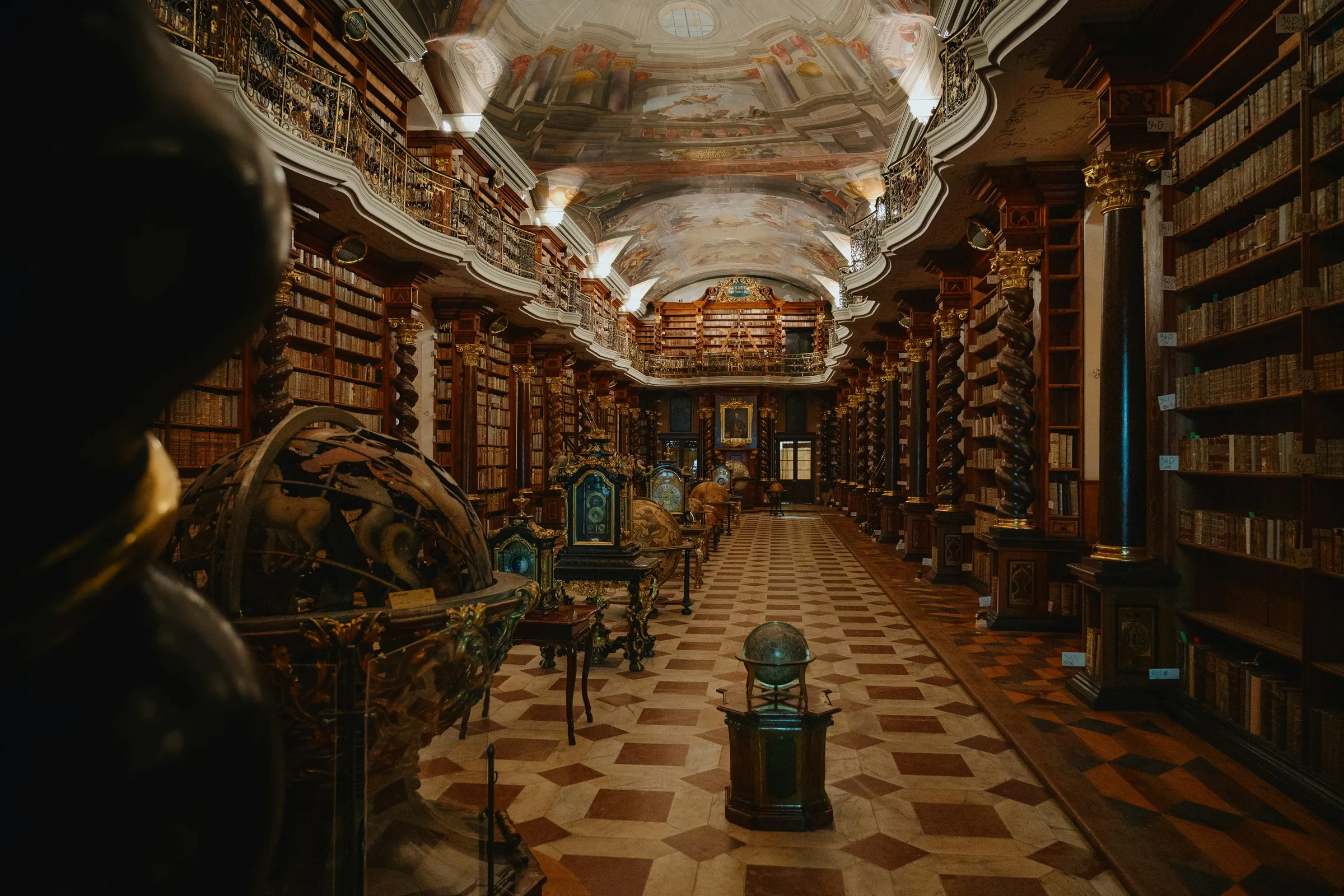
The rule that surprises visitors most: you may view the Baroque Library, but you cannot enter it. The tour brings you to the hall's threshold, and the room — the 18th-century shelves, the frescoed vault, the historic globes — is taken in from that viewing position. The barrier is conservation, not theatre. The hall preserves its centuries-old climate along with its books, and several hundred thousand visitor footsteps a year across its floor would end it. The viewing time is genuinely sufficient to study the room; bring your eyes rather than your expectations of a walk-through.
If a look-but-don't-enter library sounds like half an experience, the structure of the route compensates: the library is one of three stops, and the other two — the Meridian Hall with its period instruments and the tower gallery with its city panorama — are fully immersive. Most visitors leave rating the tower as the highlight, with the library viewing as the room they'll describe at dinner.
The guided format has practical consequences worth planning around. Departure times are fixed, so the tour anchors your day the way a restaurant reservation does — you build the morning or afternoon around it rather than drifting in when convenient. Groups are kept small enough to move through the narrow staircases as a unit, which keeps the experience civilised but caps capacity: when a departure is sold through, there is no standing-room version of it. And because each departure runs in a stated language, the slot you choose matters twice — for your schedule and for whether you understand a word your guide says. Check the language marked on each departure before you commit.
The route, stop by stop
The sightseeing route has three principal stops. First, the view into the Baroque Library — the hall completed during the college's 1709–1726 building phase, with its two-storey shelving and ceiling fresco. Your guide covers the room's history from the threshold while the group takes it in. This is the stop where you'll want to be near the front of the group; sightlines at the doorway reward the first arrivals.
Second, the climb begins, pausing at the Meridian Hall on the tower's second floor. This chamber, ringed with period astronomical instruments, is where Prague's solar noon was determined — a beam of sunlight through a wall slit crossing a string on the floor — and from 1842 to 1928 a flag waved from the gallery above announced the moment to the whole city. It's the most story-dense room on the route, and the one where a good guide earns their keep.
Third, the summit: the open-air gallery at 52 metres, reached by the full 172 steps, circling the tower below the lead Atlas statue that has crowned it since 1723. The panorama covers the castle, the bridge, the Old Town's roofscape and the river in one continuous sweep — and the gallery doubles as the walkway of the meteorological station that has recorded daily measurements since 1 January 1775. Time at the top is built into the tour; it's enough for photographs and a full circuit of the balustrade.
The 172 steps — an honest fitness check
The tower climb is the physical crux of the visit: 172 steps up a steep, winding staircase to the gallery at 52 metres, on a 68-metre tower, with no lift at any point. The guided route as a whole is not wheelchair accessible, and the operator states this plainly rather than burying it — the staircases are original Baroque fabric and cannot be retrofitted. If stairs are a hard limit, the Klementinum's interiors unfortunately have no step-free variant of the tour.
For most visitors, the climb is effort rather than obstacle. The staircase is narrow and the pitch is real, but the route breaks the ascent — the Meridian Hall stop sits partway up, functioning as a natural landing with the best possible excuse to catch your breath among the quadrants and sundials. Groups climb together at a civilised pace set by the guide, not a race. Sensible shoes matter more than fitness; the treads are worn smooth by three centuries of astronomers.
Two practical cautions. The gallery is open-air: it's the reward on a clear day and bracing in wind or winter, so dress for the exposure even if the streets below feel mild. And the descent is the same 172 steps — visitors with knee trouble regularly report the way down as the harder half. Take the handrail and let the group spread out.
Photography — what you can and cannot shoot
Manage your expectations here, because the Klementinum's most photographed room is the one with the tightest rules. Photography is restricted through much of the tour, and in the Baroque Library especially the working policy has been no photography, to protect the historic interior and collections. Those glowing library images in circulation are overwhelmingly licensed or press shots taken under controlled conditions, not visitor snapshots. Plan to experience the hall directly — it is genuinely better in person than through a screen you're not allowed to raise.
The policy softens as you climb. The tower gallery is the route's photographic payoff, and the panorama from 52 metres is unrestricted: castle, bridge, red roofs, river. If your visit has a photographic purpose, aim your booking at the light — morning slots put sun on the castle side, late-day slots warm the Old Town roofs, and the 9:00 departures give you a gallery with the fewest elbows.
Rules of this kind get adjusted over time — stricter after incidents, occasionally relaxed for hand-held phone use — so treat the current policy as something to confirm at booking or with your guide at the meeting point rather than something to assume from an old blog post. Whatever the day's rule is, flash and tripods are the two constants that stay banned in historic interiors; leave the tripod at your hotel.
From the gallery, the shot list writes itself, but a few compositions outperform the rest: the Atlas statue against the sky from the gallery below it; Prague Castle framed above the rooftops on the western side; the twin Týn spires rising from the Old Town's roof-sea to the east; and straight down into the Klementinum's own courtyards, an angle on the complex nobody at street level ever sees. A phone handles all of these; if you carry a camera, a modest wide-angle earns its place and a long lens mostly doesn't — the panorama is the subject, not the details.
Tickets, timing and the fine print
The operating pattern is unusually generous: the route runs Monday to Sunday, 9:00 to 20:00, January through December. Departures are timed, and the schedule of upcoming slots — including each tour's language — is published with the booking calendar; new tickets are released every Monday covering the following two weeks. That release rhythm is worth knowing in high season: if your dates are more than two weeks out, the slots you want may simply not exist yet, and if they're inside the window, the popular English departures thin out fast.
The day's first departures are the connoisseur's choice — a 9:00 tour in English, with a Czech departure shortly after. Early slots mean the quietest staircase, the emptiest gallery and the easiest positions at the library threshold; they also leave the whole day open, since the tour occupies less than an hour. Arrive at the meeting point beside the Mirror Chapel about ten minutes ahead — the route moves as one group, and there's no catching up through a timed sequence of rooms once it leaves.
The fine print is short but real. Children up to 15 must be accompanied by an adult. Reduced-rate categories exist for young people, seniors and families, and the concession tiers require valid ID at entry, so carry the document, not a photo of it. And because the complex is a working library, the tour's quiet-voice convention at the library threshold is enforced with genuine seriousness — the only rule on the route that visitors break by accident.
Seasonally, the calculus shifts. In July and August, treat English departures as scarce goods and book the Monday the window opens; in the November-to-February trough you can often decide the day before, and the 9:00 tour may feel semi-private. Winter visits carry one bonus and one warning: the low sun makes the Meridian Hall's light-slit geometry easiest to appreciate, and the open gallery at 52 metres is seriously cold in a north wind — the one part of the visit where January demands gloves.
Frequently asked
How long does the Klementinum tour take?
The guided route itself runs about 45 to 50 minutes depending on the guide's pace, covering the Baroque Library viewing, the Meridian Hall and the Astronomical Tower gallery. Door to door — finding the meeting point, the tour, and time in the courtyards — plan on roughly 90 minutes. If you're pairing the visit with Charles Bridge or Old Town Square, the tour slots cleanly into a morning without dominating it.
Can I climb the Astronomical Tower without taking the tour?
No. The tower, the Meridian Hall and the Baroque Library viewing are accessible only on the guided sightseeing route with timed departures. The internal courtyards are free to walk through, but every interior on the route is guided-access only.
Is there a lift up the Klementinum tower?
No — the gallery at 52 metres is reached only by 172 steep, winding steps, and the route is not wheelchair accessible. The Meridian Hall stop partway up breaks the climb, and the group ascends at a guided pace, but there is no step-free alternative for the tower or the tour. Visitors who can manage stairs slowly will find the guided pace forgiving; the group waits at each stop rather than pressing on.
Can I take photos inside the Baroque Library?
Expect not to — photography has generally not been permitted in the library, to protect the historic interior, while the open-air tower gallery is unrestricted and delivers the tour's best shots. Policies can change, so confirm the current rule when you book or at the meeting point. Flash and tripods are banned in the interiors regardless.
When are Klementinum tickets released?
New tickets are released every Monday for the following two weeks, with the timed schedule showing each departure's language. Tours run daily 9:00 to 20:00 year-round. Inside the two-week window, English departures at popular times sell through first — book as early in the window as you can.
Do visitors ever get to walk inside the Baroque Library hall?
No — the tour brings you to the hall's threshold and you view the room from there. The restriction preserves the hall's climate and its historic collection. The viewing stop is long enough to study the frescoes, globes and shelving properly; the fully walkable parts of the route are the Meridian Hall and the tower gallery.